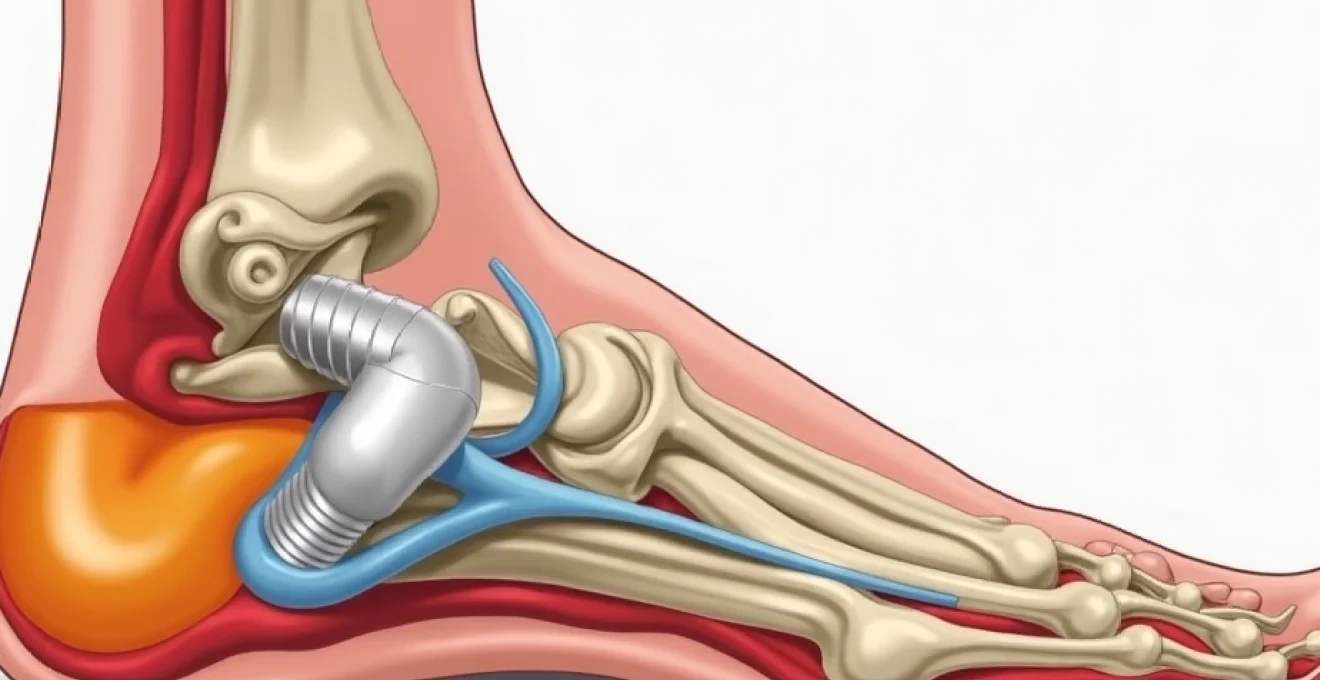
Subtalar joint fusion represents a definitive surgical intervention for addressing severe hindfoot pathology, yet the procedure can paradoxically generate new sources of heel pain that challenge both patients and clinicians. While subtalar arthrodesis effectively eliminates motion at the targeted joint and typically provides substantial pain relief from the primary pathology, the biomechanical alterations inherent to this procedure can precipitate a cascade of compensatory changes throughout the foot and ankle complex. Understanding these potential complications becomes crucial for healthcare professionals managing post-operative patients who experience persistent or newly developed heel pain following what was intended to be a curative procedure.
The complexity of heel pain following subtalar fusion stems from the intricate interplay between altered joint mechanics, surgical technique variables, and the body’s adaptive responses to permanent structural changes. Post-arthrodesis complications can manifest immediately following surgery or develop gradually over months to years as compensatory mechanisms evolve and adjacent structures experience increased stress loading.
Anatomical changes following subtalar joint arthrodesis
The subtalar joint complex facilitates critical hindfoot motion patterns that become permanently altered following successful arthrodesis. This joint normally allows approximately 20-30 degrees of combined inversion and eversion motion, which proves essential for normal gait mechanics and adaptation to uneven terrain. When this motion becomes eliminated through surgical fusion, the entire kinetic chain of the lower extremity must compensate through alternative movement strategies.
Altered hindfoot biomechanics and weight distribution patterns
Subtalar fusion fundamentally changes how forces transmit through the hindfoot during weight-bearing activities. The normal subtalar joint functions as a torque converter, allowing the leg to rotate internally and externally while maintaining foot contact with the ground. Following fusion, this conversion mechanism becomes eliminated, forcing adjacent joints to accommodate rotational stresses they were not designed to handle efficiently.
Research demonstrates that patients with subtalar fusion experience altered pressure distribution patterns beneath the heel, with some areas experiencing increased loading while others become relatively unloaded. This redistribution can create focal points of excessive pressure that generate pain in previously asymptomatic regions of the heel. The calcaneal tuberosity, in particular, may experience altered loading patterns that contribute to plantar heel pain syndromes.
Adjacent joint compensation mechanisms in the chopart complex
The Chopart joint complex, comprising the talonavicular and calcaneocuboid articulations, assumes increased functional demands following subtalar fusion. These joints attempt to compensate for lost subtalar motion by increasing their range of movement and accommodating forces previously managed by the subtalar joint. This compensation mechanism can lead to accelerated wear patterns and the development of secondary arthritic changes.
The talonavicular joint, positioned medially within the Chopart complex, becomes particularly susceptible to overuse following subtalar fusion. Patients often develop medial heel pain as this joint experiences increased stress during the stance phase of gait. The calcaneocuboid joint laterally may similarly develop painful arthritic changes as it attempts to compensate for lost subtalar eversion motion.
Tibiotalar joint hypermobility and increased stress loading
The ankle joint frequently develops hypermobility patterns following subtalar fusion as it attempts to compensate for lost hindfoot motion. This compensatory hypermobility can create instability sensations and contribute to heel pain through altered loading patterns during weight-bearing activities. The increased stress on tibiotalar joint structures may accelerate degenerative changes and contribute to chronic pain syndromes.
Ankle joint hypermobility following subtalar fusion often manifests as increased dorsiflexion and plantarflexion motion as patients attempt to maintain functional flexibility for activities of daily living. However, this increased motion occurs without the normal stabilising influence of subtalar joint mechanics, potentially creating aberrant movement patterns that generate heel discomfort.
Plantar fascia tension alterations following calcaneal position changes
Subtalar fusion often involves correction of hindfoot deformity, which can significantly alter the position of the calcaneus relative to surrounding soft tissue structures. Changes in calcaneal pitch, height, or rotation can modify tension patterns within the plantar fascia, potentially creating new sources of heel pain even in patients without pre-operative plantar fasciitis.
The plantar fascia’s attachment to the medial calcaneal tuberosity becomes particularly vulnerable to tension changes following hindfoot realignment. Patients may develop secondary plantar fasciitis as altered foot mechanics place increased stress on this critical soft tissue structure. The development of heel spurs at the plantar fascial insertion represents a common long-term consequence of these altered tension patterns.
Surgical Technique-Related pain aetiologies
Hardware-related complications represent a significant source of post-operative heel pain following subtalar fusion procedures. The surgical approach, hardware selection, and positioning techniques all influence the likelihood of developing technique-related pain syndromes. Understanding these potential complications allows surgeons to modify their approach and patients to recognise symptoms that may require intervention.
Hardware-associated complications from cannulated screw placement
Cannulated screws remain the most commonly utilised fixation method for subtalar fusion procedures, yet their placement can create various sources of heel pain. Screws that protrude beyond the intended bony boundaries may irritate adjacent soft tissues, creating focal points of discomfort during weight-bearing activities. The heads of screws positioned too prominently can create pressure points against footwear or adjacent anatomical structures.
Screw malposition represents another common source of hardware-related heel pain. Screws that violate the subtalar joint space inadequately or extend into adjacent joints can create ongoing pain despite successful fusion healing. Additionally, screws that become loose over time may migrate and create new sources of irritation or pain as they move within the bone.
The phenomenon of screw backout can develop months or years following surgery as bone remodelling occurs around the fusion site. Backed-out screws may create prominent areas under the skin that become painful with shoe wear or direct pressure. Some patients require hardware removal procedures to address these delayed complications.
Sinus tarsi impingement syndrome Post-Arthrodesis
The sinus tarsi represents a complex anatomical space between the talus and calcaneus that contains important ligamentous structures, proprioceptive nerve endings, and fat pad tissue. Subtalar fusion procedures can disrupt this space through direct surgical trauma or alterations in hindfoot positioning that compress residual soft tissues within the sinus tarsi.
Patients with sinus tarsi impingement typically experience lateral heel pain that worsens with activity and may be accompanied by a sensation of instability or giving way. The pain often localises to the area just anterior and inferior to the lateral malleolus, where the sinus tarsi opens laterally. This condition can develop immediately following surgery or evolve gradually as scar tissue formation and joint positioning changes occur.
Lateral calcaneal wall irritation from protruding metalwork
The lateral calcaneal wall provides an important attachment site for various soft tissue structures and can become irritated when surgical hardware protrudes beyond the bone’s natural contours. This complication most commonly occurs when screws are over-advanced or when plate fixation extends too far laterally along the calcaneal body.
Lateral wall irritation typically presents as activity-related heel pain that may be accompanied by local swelling or tenderness to palpation. Patients often report difficulty wearing certain types of footwear due to pressure over the affected area. In severe cases, the protruding hardware may create chronic inflammation of surrounding soft tissues, requiring surgical revision or hardware removal.
Nerve entrapment of medial calcaneal branches
The medial calcaneal nerve branches provide sensation to the medial heel and plantar surface of the hindfoot. These nerve structures can become entrapped or irritated during subtalar fusion procedures, particularly when medial surgical approaches are utilised or when post-operative swelling compresses nerve pathways.
Medial calcaneal nerve entrapment typically manifests as burning, tingling, or numbness along the medial heel region. Patients may experience shooting pains that radiate from the heel into the arch or medial forefoot. This neuropathic pain often proves resistant to conventional pain management strategies and may require specific treatments targeting nerve dysfunction.
Non-union and malunion sequelae
Non-union represents one of the most significant complications following subtalar fusion, occurring in approximately 10-15% of cases according to current literature. When the intended fusion fails to occur, patients typically experience ongoing motion at the surgical site, which can generate persistent heel pain that may be worse than their pre-operative symptoms. The failed fusion site often becomes a source of chronic inflammation and mechanical instability that affects the entire hindfoot complex.
Patients with subtalar non-union frequently describe their heel pain as deep, aching, and worsened by weight-bearing activities. The pain may be accompanied by clicking or grinding sensations as abnormal motion occurs at the incompletely fused joint surfaces. Advanced imaging studies typically reveal persistent joint space or hardware loosening at the fusion site, confirming the diagnosis of non-union.
Malunion represents another significant complication where the bones heal in an incorrect position, creating altered foot mechanics that can generate various pain patterns throughout the heel and hindfoot. Malunion sequelae often prove more challenging to manage than non-union complications because revision surgery requires correction of established bone healing rather than simply promoting fusion at a mobile site.
Patients with malunion following subtalar fusion often experience heel pain related to altered weight distribution patterns and compensatory stress loading in adjacent joints and soft tissue structures.
The correction of malunion typically requires complex revision procedures that may include osteotomy, bone grafting, and repeat fusion attempts. These revision surgeries carry higher complication rates and less predictable outcomes compared to primary fusion procedures. Patients must understand that malunion correction may involve multiple surgical stages and extended recovery periods.
Adjacent joint arthritis development
The development of arthritis in joints adjacent to a subtalar fusion represents a predictable long-term consequence of altered foot mechanics. When the subtalar joint becomes fused, the normal distribution of forces throughout the hindfoot complex changes dramatically, placing increased stress on remaining mobile articulations. This increased stress loading accelerates the development of degenerative changes in previously healthy joints.
Talonavicular joint degeneration secondary to motion loss
The talonavicular joint assumes increased functional demands following subtalar fusion as it attempts to compensate for lost hindfoot motion. This joint normally contributes to hindfoot flexibility during gait, but following subtalar fusion, it must accommodate forces and motion patterns beyond its physiological capacity. The result is accelerated wear of articular cartilage and the development of secondary osteoarthritis.
Patients with talonavicular arthritis following subtalar fusion typically experience medial heel and midfoot pain that worsens with weight-bearing activities. The pain often radiates from the medial heel into the arch and may be accompanied by swelling over the talonavicular joint region. Advanced cases may develop significant deformity as the joint collapses under increased stress loading.
Research indicates that talonavicular joint arthritis develops in approximately 30-40% of patients within five years following subtalar fusion. The risk appears highest in patients who underwent fusion for post-traumatic arthritis or those with significant pre-operative deformity correction. Early recognition and appropriate management of talonavicular arthritis can help preserve function and prevent progression to severe deformity.
Calcaneocuboid joint arthritic changes and pain patterns
The calcaneocuboid joint represents the lateral component of the Chopart joint complex and frequently develops secondary arthritis following subtalar fusion. This joint must accommodate increased eversion forces as it attempts to compensate for lost subtalar motion, leading to accelerated cartilage wear and eventual joint degeneration.
Calcaneocuboid arthritis typically manifests as lateral heel and midfoot pain that may extend into the lateral border of the foot. Patients often experience difficulty with push-off during gait as the arthritic joint becomes painful with loading. The development of bone spurs around the calcaneocuboid joint can create additional sources of pain through soft tissue impingement.
The progression of calcaneocuboid arthritis following subtalar fusion appears related to the degree of motion compensation required and the patient’s activity level. High-demand patients or those with significant pre-operative deformity face increased risk for developing symptomatic calcaneocuboid arthritis within the first several years following subtalar fusion.
Tibiotalar joint accelerated wear following subtalar fusion
The ankle joint experiences altered loading patterns following subtalar fusion that can accelerate the development of degenerative changes. The normal coupling between subtalar and ankle joint motion becomes disrupted, creating abnormal stress concentrations within the tibiotalar articulation during weight-bearing activities.
Tibiotalar arthritis following subtalar fusion often presents as deep ankle pain that may radiate into the heel region. Patients typically experience stiffness and pain with dorsiflexion and plantarflexion motions, particularly during activities that require ankle flexibility such as stair climbing or walking on inclined surfaces.
The development of ankle arthritis following subtalar fusion represents a particularly challenging complication because both joints become compromised, severely limiting hindfoot function. Triple arthrodesis procedures may become necessary in advanced cases, but these extensive fusions create significant functional limitations and their own set of potential complications.
Soft tissue pathology and tendon dysfunction
Soft tissue structures surrounding the subtalar joint can develop various pathological conditions following fusion surgery that contribute to heel pain syndromes. The altered biomechanics created by subtalar fusion place increased demands on tendons, ligaments, and fascial structures that must adapt to new loading patterns and movement strategies.
The posterior tibial tendon frequently develops dysfunction following subtalar fusion as it attempts to compensate for lost hindfoot motion. This tendon normally works in conjunction with subtalar joint motion to control hindfoot position during gait, but following fusion, it must function in an altered biomechanical environment. Posterior tibial tendon dysfunction can manifest as medial heel pain, arch pain, and progressive flat foot deformity in the remaining mobile joints.
Peroneal tendon pathology represents another common source of heel pain following subtalar fusion. These lateral tendons must accommodate increased eversion demands as they attempt to compensate for lost subtalar motion. The result can be tendinitis, tenosynovitis, or even tendon rupture in severe cases. Patients with peroneal tendon dysfunction typically experience lateral heel pain that worsens with activity and may be accompanied by swelling or clicking sensations along the lateral ankle region.
The Achilles tendon can develop adaptive shortening or dysfunction following subtalar fusion as altered hindfoot mechanics affect the relationship between the tendon and its calcaneal insertion. Some patients develop insertional Achilles tendinitis at the posterior heel as the tendon adapts to new loading patterns created by the fused subtalar joint.
Soft tissue complications following subtalar fusion often develop gradually over months to years as compensatory mechanisms evolve and surrounding structures adapt to altered foot mechanics.
Treatment of soft tissue pathology following subtalar fusion typically requires a multimodal approach including physical therapy, orthotic management, and sometimes additional surgical interventions. Early recognition and treatment of developing soft tissue problems can help prevent progression to more severe complications that may require complex reconstructive procedures.
Complex regional pain syndrome and neuropathic pain states
Complex Regional Pain Syndrome (CRPS) represents a devastating complication that can develop following subtalar fusion surgery, characterising itself through severe, disproportionate pain accompanied by autonomic dysfunction and inflammatory changes. This condition affects approximately 2-5% of patients undergoing foot and ankle surgery, with subtalar fusion procedures carrying particular risk due to the extensive soft tissue dissection and bone work required.
CRPS following subtalar fusion typically manifests as severe, burning heel pain that appears disproportionate to the expected post-operative discomfort. Patients often describe allodynia, where normally non-painful stimuli such as light touch or clothing contact create severe pain sensations. The affected heel may develop colour changes, temperature alterations, and abnormal sweating patterns that indicate autonomic nervous system dysfunction.
The development of CRPS can transform a previously successful surgical outcome into a source of chronic disability. Early recognition becomes crucial because prompt treatment with aggressive physical therapy, sympathetic nerve blocks, and specific medications can help prevent progression to the chronic, irreversible stages of this condition. Unfortunately, once CRPS becomes established, it often proves resistant to treatment and can create lifelong functional limitations.
Neuropathic pain states can also develop following subtalar fusion through various mechanisms including nerve
injury during surgery, post-operative nerve compression from swelling or scar tissue formation, or sensitisation of pain pathways following prolonged nociceptive input. The sural nerve, medial calcaneal nerve, and lateral plantar nerve all traverse areas commonly affected during subtalar fusion procedures, making them vulnerable to injury or dysfunction.
Patients with neuropathic pain following subtalar fusion often describe shooting, electric-like sensations that may radiate from the heel into the foot or up the leg. Unlike typical post-operative pain that gradually improves with healing, neuropathic pain may persist or even worsen over time. This type of pain often proves resistant to standard analgesics and may require specific neuropathic pain medications such as gabapentin, pregabalin, or tricyclic antidepressants.
The distinction between CRPS and other neuropathic pain states becomes important for treatment planning. While both conditions can create severe, chronic pain following subtalar fusion, their underlying mechanisms and treatment approaches differ significantly. CRPS involves sympathetic nervous system dysfunction and inflammatory processes, while other neuropathic pain states primarily involve peripheral or central nerve sensitisation without autonomic involvement.
Prevention strategies for both CRPS and neuropathic pain include meticulous surgical technique to minimise nerve trauma, aggressive post-operative pain management to prevent central sensitisation, and early mobilisation when medically appropriate. Patients who develop early signs of either condition require immediate intervention to prevent progression to chronic, treatment-resistant states.
Early recognition and aggressive treatment of neuropathic pain complications following subtalar fusion can significantly improve long-term outcomes and prevent the development of chronic pain syndromes that may prove refractory to conventional treatments.
The psychological impact of chronic pain following subtalar fusion cannot be underestimated. Patients who expected significant improvement from their surgery may experience depression, anxiety, or loss of function when complications develop. A multidisciplinary approach including pain specialists, physical therapists, and mental health professionals often becomes necessary to address the complex needs of patients with chronic pain complications following subtalar fusion procedures.