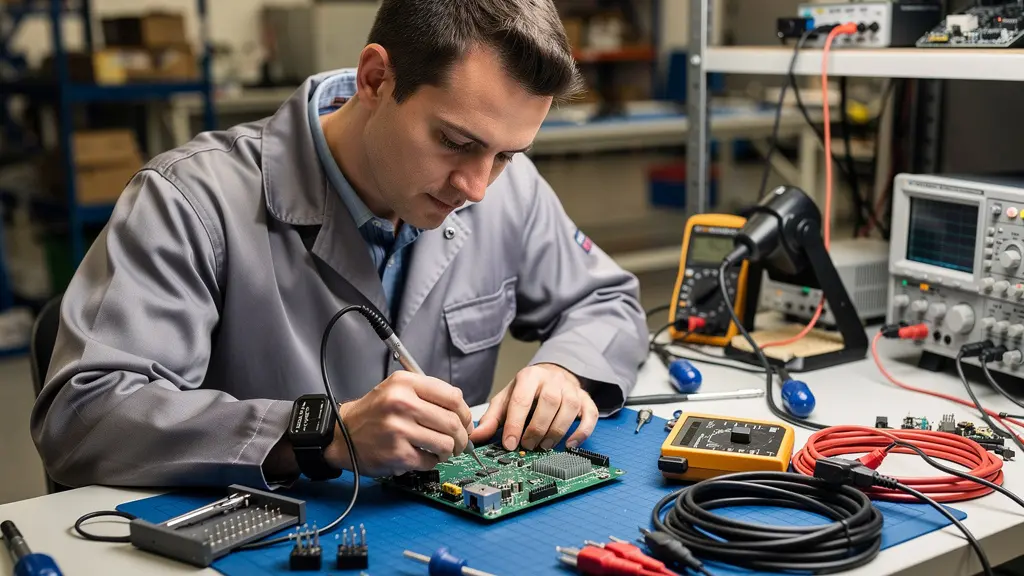
I walked into a Birmingham facility last year where the production supervisor, Marcus, had every piece of ESD equipment you could want. Mats on the floor. Mats on the benches. Wrist straps at every station. He had just failed his third-party audit. The reason? Not a single piece of it was actually earthed. The grounding cables traced back to a bus bar that someone had disconnected during a renovation three years earlier. Five days of production halted.
EPA Zone Setup in 60 Seconds
- Verify your earth connection first—equipment without proper earthing provides zero protection
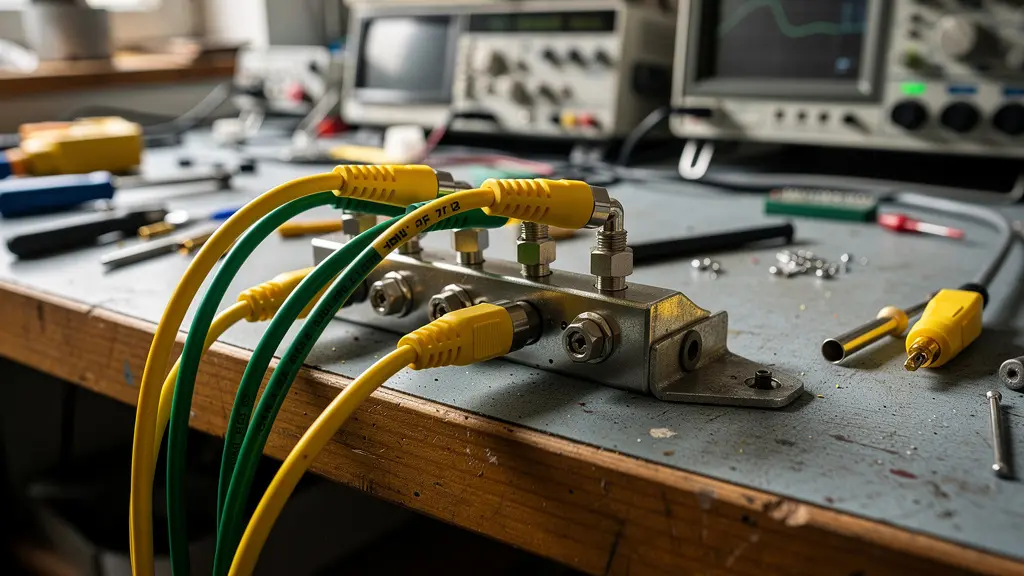
- Essential kit: table mat, floor mat, wrist strap, grounding cords, common point ground
- Resistance targets: worksurfaces below 1.0×10⁹Ω to ground, wrist straps below 3.5×10⁷Ω
- Test daily (wrist straps) and monthly (mats and surfaces)
- Document everything—auditors check records, not just equipment
What You’ll Find in This Guide
What Makes an EPA Zone Actually Work
Here is what most guides get backwards. They start with a shopping list. Buy this mat. Buy that wrist strap. But buying ESD products does not equal protection. I have audited facilities with thousands of pounds of equipment that offered precisely zero actual protection because nobody verified the earthing chain.
An EPA zone works on one principle: every static charge must have a controlled path to earth. Break that chain anywhere and everything downstream becomes theatre. According to EN 61340-5-1 resistance specifications, your worksurfaces need resistance to ground below 1.0×10⁹Ω. Miss that threshold and you have an expensive collection of coloured mats.
25%
Electronic component failures attributed to ESD damage
The stakes are real. According to industry ESD damage statistics, roughly a quarter of all identified electronic part failures trace back to static discharge. The insidious part? Components can sustain damage from voltages as low as 20 volts—well below the roughly 3,500 volts you need to actually feel a zap. Your operators could be destroying parts all day without noticing a thing.
The Invisible Damage Problem: Most ESD damage creates latent defects. The component passes initial testing but fails weeks or months later in the field. Your customer gets the warranty claim. You get the reputation hit.
Essential Equipment for Your EPA Zone
Think of your EPA zone as a chain. Each link connects to the next, and one weak link breaks the entire system. I am going to walk you through what actually matters, separating the essentials from the nice-to-haves. Because frankly, you can blow your entire budget on gold-plated solutions when a pragmatic setup covers ninety percent of real-world requirements.
Flooring and Work Surface Protection
Your dissipative surfaces—table mats and floor mats—create the controlled discharge path for both components and personnel. The IEC 61340-5-1:2024 edition requirements specify that insulators (materials above 1.0×10¹¹Ω resistance) must be kept away from ESD-sensitive items. Everything on your work surface needs to either dissipate charge or be removed. No exceptions.
For most electronics assembly, a two-layer rubber mat works perfectly. The top layer dissipates charge slowly enough to protect sensitive components. The bottom layer ensures proper contact with your grounding cord. When you are looking at ESD protected area requirements, prioritise mats that come with grounding cords and snap fasteners included—it eliminates compatibility guesswork.
The Cleaning Product Trap: In my site assessments across UK electronics manufacturers, the single most common mistake I encounter is using standard cleaning sprays on ESD table mats. Household cleaners leave an insulating residue that renders the mat useless within weeks. Stick to ESD-approved mat cleaners or you will be replacing mats every few months.
Personal Grounding Equipment
Wrist straps remain the primary method for keeping operators at the same potential as the work surface. The strap must connect to your common point ground with total resistance below 3.5×10⁷Ω. That 1MΩ resistor in the coil cord is not optional—it limits current flow and protects operators from electrical hazard.
Heel straps and ESD footwear offer an alternative for mobile workers, but only if you have dissipative flooring throughout the movement area. For seated assembly work, wrist straps win every time. They are simpler, cheaper to maintain, and easier to verify.
Supporting Items and Consumables
Beyond the core equipment, you need items that maintain the integrity of your EPA zone. Signage marks boundaries and reminds staff of procedures. ESD-safe packaging keeps components protected during storage and transport. Ionisers neutralise charge on insulators you cannot remove from the work area.
| Equipment | Priority Level | Typical Cost | Skip-If Scenario |
|---|---|---|---|
| Table mat with grounding cord | Essential | £40-80 | Never skip |
| Wrist strap with coil cord | Essential | £8-25 | Never skip |
| Common point ground | Essential | £15-40 | Never skip |
| Floor mat | Recommended | £80-200 | Stationary seated work only |
| Ioniser | Optional | £150-400 | No insulators in work area |
Step-by-Step EPA Zone Installation
Installation sequence matters more than most people realise. Get this wrong and you will spend hours troubleshooting connectivity issues that should never have existed. What follows is the sequence I use when commissioning new EPA zones—it has saved me from Marcus-style disasters more times than I can count.
Installation Sequence (7 Steps)
-
Verify mains earth
Test your mains socket earth before anything else. Use a socket tester or multimeter. If earth is faulty, stop—nothing else matters until this is sorted.
-
Install common point ground
Mount your earth bonding point and connect it to verified mains earth. This becomes the single reference point for all EPA equipment.
-
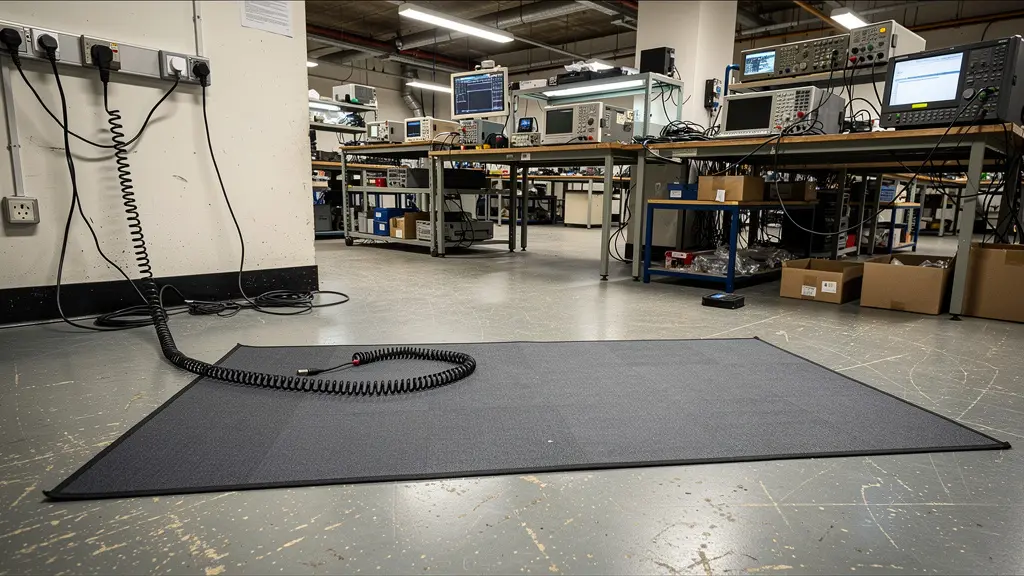
Lay floor mat
Position mat, attach grounding cord to common point ground. Verify resistance from mat surface to ground—should read below 1.0×10⁹Ω.
-
Install table mat
Secure mat to work surface, connect grounding cord to common point ground. Test resistance surface to ground.
-
Set up wrist strap station
Connect wrist strap banana plug to grounding point. Test with wrist strap tester to confirm below 3.5×10⁷Ω total resistance.
-
Remove or isolate insulators
Survey work area. Anything above 1.0×10¹¹Ω resistance must be removed or kept 30cm minimum from ESD-sensitive items.
-
Document and sign off
Record all resistance measurements, photograph setup, create verification log. Your audit trail starts now.
The entire process for a single workstation typically takes under a day once equipment arrives. Larger production lines scale linearly—each additional station adds roughly the same installation time. For context on how regulations and standards in healthcare manufacturing environments apply similar systematic approaches, medical device assembly follows nearly identical EPA requirements.
-
Site assessment and equipment selection (2-4 hours) -
Equipment delivery (variable) -
Installation and initial testing (4-5 hours) -
Verification testing and sign-off (1 hour)
Testing and Maintenance That Auditors Actually Check
Below 1.0×10⁹Ω. Below 3.5×10⁷Ω. These numbers will determine whether you pass or fail. Auditors do not care how expensive your equipment was or how nice it looks. They care about resistance measurements and whether you can prove your EPA zone has been continuously maintained since the last audit.
The Numbers Auditors Check:
- Worksurface to ground: below 1.0×10⁹Ω
- Floor mat to ground: below 1.0×10⁹Ω
- Wrist strap system: below 3.5×10⁷Ω
- Humidity: 30-70% relative humidity recommended
- Insulator isolation distance: minimum 30cm from ESD-sensitive items
Testing frequency depends on your ESD control programme, but here is what I recommend as a minimum. Wrist straps get tested at the start of every shift—a simple continuity check takes seconds with a dedicated tester. Table and floor mats get monthly resistance verification. Document every test. Date, result, tester initials. No exceptions.
Practical tip: Create a laminated test log that lives at each workstation. Operators initial after each wrist strap test. Supervisors initial after monthly mat verification. When the auditor arrives, hand them the logs before they even ask. It changes the entire dynamic of the audit.
Maintenance is where most EPA zones slowly degrade. According to practical ESD control recommendations 2025, maintaining relative humidity between 30-70% significantly reduces static buildup. But humidity alone is not enough. Mats accumulate contamination. Wrist strap cords wear. Grounding connections work loose. Schedule quarterly deep inspections beyond your routine testing.
Your Questions About EPA Zone Setup
Common EPA Zone Setup Questions
What is the minimum EPA zone for a small repair workshop?
One properly grounded table mat, one wrist strap with coil cord, and a verified earth connection. That covers basic component handling. Add a floor mat if operators move between stations or stand during work.
Can I use my building’s mains earth instead of a separate ground?
Yes, mains earth is the standard approach for most EPA zones. The critical point is verification—test the socket earth before connecting any equipment. Dedicated earth rods are mainly for facilities with electrical noise issues or where mains earth proves unreliable.
How often do I need to test my EPA equipment?
Wrist straps: daily or before each shift. Table and floor mats: monthly. Common point ground: quarterly. Ionisers: per manufacturer recommendation, typically monthly. Document everything regardless of frequency.
What humidity level is too low for safe ESD control?
Below 30% relative humidity significantly increases static generation risk. However, properly selected ESD materials are qualified at humidity as low as 12%, so your equipment will still function—you simply face higher charge generation rates that your EPA zone must handle.
Do I need ESD footwear if I have floor mats?
Not necessarily. If operators remain seated with wrist straps connected, floor mats provide secondary protection without footwear. ESD footwear becomes essential when operators move frequently, work standing, or handle components away from wrist strap range.
Medical device manufacturers, aerospace assembly facilities, and electronics repair workshops all face the same fundamental EPA requirements. The scale differs, but the principles stay constant. If your work involves handling ESD-sensitive components in healthcare contexts, you will find that emergency medical supplies for clinics often include equipment with identical static protection requirements.
The Next Step for Your EPA Zone
Stop reading. Go check your earth connection. Seriously. If you have existing ESD equipment, grab a multimeter and verify the path from your work surface to mains earth right now. If everything measures within specification, brilliant—you are ahead of most facilities I audit. If not, you know exactly where to start.
Important Compliance Notes
- This guide provides general EPA zone setup principles aligned with IEC 61340 standards as of 2026
- Specific resistance values and testing frequencies may vary by industry and application
- Always verify current standards requirements as they are subject to periodic revision
- Site-specific conditions (humidity, flooring type, equipment sensitivity) require professional assessment
Risks to consider:
- Risk of component damage if grounding resistance exceeds specification limits
- Risk of audit failure if documentation and testing records are incomplete
- Risk of false security if cleaning agents compromise mat conductivity
For site-specific implementation, consult a certified ESD coordinator or third-party ESD auditor.